The Perfect Two Weeks in New Zealand's South Island: A Walker's Itinerary

In this article:
1. How long do you need in the South Island? 2. The two-week South Island itinerary at a glance 3. Days 1-2: Queenstown, Arrowtown and Aoraki / Mount Cook 4. Days 3-4: The Mackenzie, Christchurch and the coast to Kaikōura 5. Days 5-7: Kaikōura, Queen Charlotte Sound and Nelson 6. Days 8-9: Nelson Lakes and the wild West Coast 7. Days 10-11: Glacier Country, Haast and Wanaka 8. Days 12-14: Fiordland, the Kepler and Milford Sound 9. Going guided with New Zealand Trails 10. Self-drive or guided? An honest look 11. Walk the South Island with us 12. A warm welcome southYou come round a corner on the winding beech-forest-lined road to Milford Sound, and suddenly the jaw-dropping Eglinton Valley opens up before you - a wide, glacier-carved valley flanked on either side by the epitome of New Zealand's Southern Alps. It's a moment you know will stick with you for the rest of your life and one you've been dreaming of all these long years.
Without a doubt, New Zealand's South Island is one of the most stunningly beautiful destinations in the world for hiking, walking and exploring the great outdoors, and the good news is that two weeks is genuinely enough to see the very best of it (if you build the route well). The best news is that we've already built it for you. Here is the two-week New Zealand South Island itinerary we would hand a good friend, step by step, from the company that’s been doing this (and winning awards for it) for over 15 years.
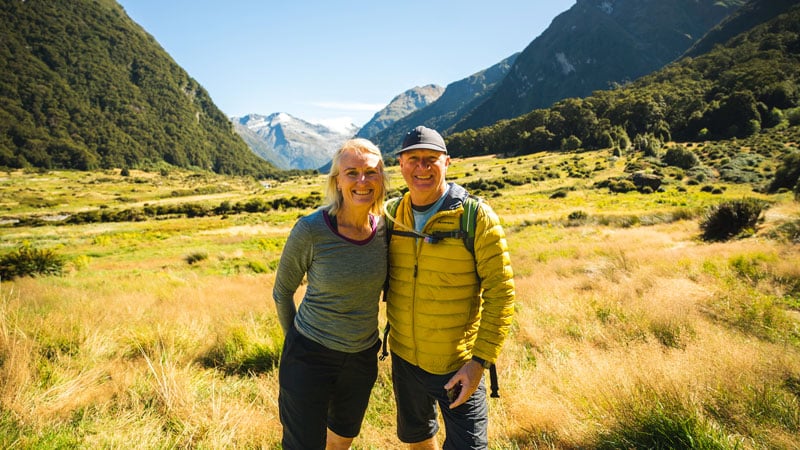
Fiordland National Park showcases New Zealand's wild beauty, with vast mountains, forests, and valleys extending into the distance.
How long do you need in the South Island?
So, how many days do you really need? It is the first question every planner asks, and the honest answer is: more than you think, and you will still leave wanting another week.
Here is the quick version. Ten days in New Zealand is enough for a focused South Island loop if you keep your stops few and your driving tight, though you will be choosing between Aoraki and Fiordland rather than savouring both. To really do it justice without feeling rushed, two weeks is the sweet spot. Long enough to walk beneath Aoraki / Mount Cook, swim with dolphins at Kaikōura, wander the wild West Coast and its glacier country, hike a section of the Kepler, and still see Milford Sound properly, all without sprinting.
If you only have five days, do not try to "see the South Island". Pick one corner, Queenstown and Fiordland is our pick, and go deep. A well-paced week prioritising quality over quantity beats a frantic rush every time.
A word on timing, because when you visit makes all the difference. New Zealand's summer falls during Northern Hemisphere winter, with our walking season running from spring (October) through autumn (April), with the long, warm days of December to February the heart of it. If you are weighing months, we have written a full guide to the best time of year to walk this route. For now, know that booking 12 to 18 months ahead is the norm if you want to secure your preferred dates.
| Trails Tip |
|---|
| Though there's never a bad time to explore New Zealand, if you ask one of our local guides, they'll tell you that for the quietest trails, most vibrant colours, and most comfortable temperatures for exploring outdoors, Spring or Autumn are their favourite picks. |
The two-week South Island itinerary at a glance
Before we go day by day, here’s a quick breakdown of the entire itinerary: a grand loop of the South Island that starts and finishes in Queenstown, threading the mountains, the coast, wine country, the wild West Coast, and the fiords into one unforgettable fortnight.
| Days | Where | Headline walks & experiences |
|---|---|---|
| 1-2 | Queenstown to Aoraki / Mount Cook | Arrow River Trail; Sealy Tarns or the Hooker Valley lookout |
| 3-4 | The Mackenzie, Christchurch and Kaikōura | Pukaki lakeshore walk; Godley Head coastal track |
| 5-7 | Kaikōura, Queen Charlotte Sound and Nelson | Swim with dusky dolphins; kayak Queen Charlotte Sound |
| 8-9 | Nelson Lakes and the West Coast | Whisky Falls; the Pororari Loop and the Pancake Rocks |
| 10-11 | Glacier Country, the Haast and Wanaka | Lake Matheson; Diamond Lake and Rocky Mountain |
| 12-14 | Fiordland, the Kepler and Milford Sound | A day on the Kepler; the Milford Sound cruise |
Short on time? Grab the full Masterpiece itinerary here.
All in all, over 14 days you’ll circumnavigate the entire South Island, taking in the best of each region with our local know-how. You’ll explore New Zealand’s most iconic locations, discover hidden gems most visitors never see, and experience true Kiwi hospitality at the hands of our expert local guides. If that sounds like the trip for you, read on. Here’s the day-to-day detail where our local knowledge really shines through.
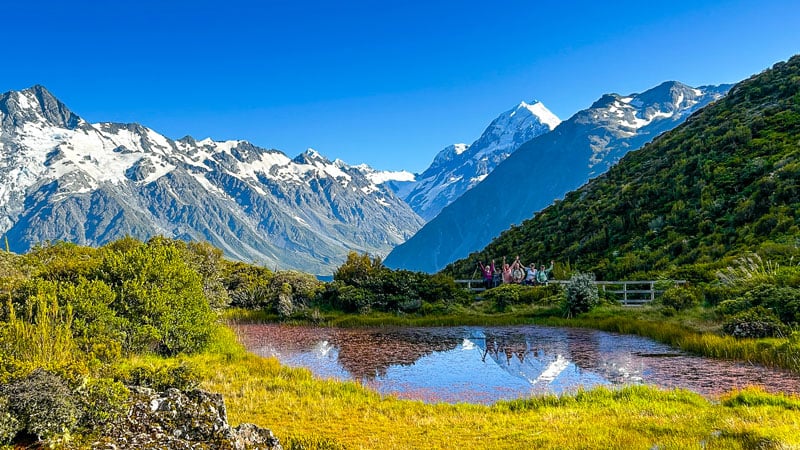
Our South Island trips explore some of New Zealand's most remarkable landscapes, from alpine peaks and glacial lakes to rugged coastlines and native forests.
Days 1-2: Queenstown, Arrowtown and Aoraki / Mount Cook
Arrowtown and the Arrow River
Your fortnight begins in Queenstown, the alpine resort town strung along the shore of Lake Wakatipu (Whakatipu Waimāori in te reo Māori). Once you have met your travelling companions, the gentlest of starts is a short drive to historic Arrowtown, a beautifully preserved gold-mining settlement, for a walk on the Arrow River Bridges Trail. It is a local favourite, easy underfoot, and a lovely way to shake off the long-haul flight among the autumn poplars and the old miners' cottages.
From there, the road runs north over the Lindis Pass, the tussock turning gold as you climb, and down into the Mackenzie. Your first glimpse of Aoraki / Mount Cook, New Zealand's highest mountain at 3,724 metres (12,218 feet), is one you will not forget. Aoraki is often translated as "the cloud piercer", and the maunga (mountain) is a revered ancestor in the tradition of Ngāi Tahu, the South Island iwi (tribe). You will spend two nights up here, beneath the peaks.
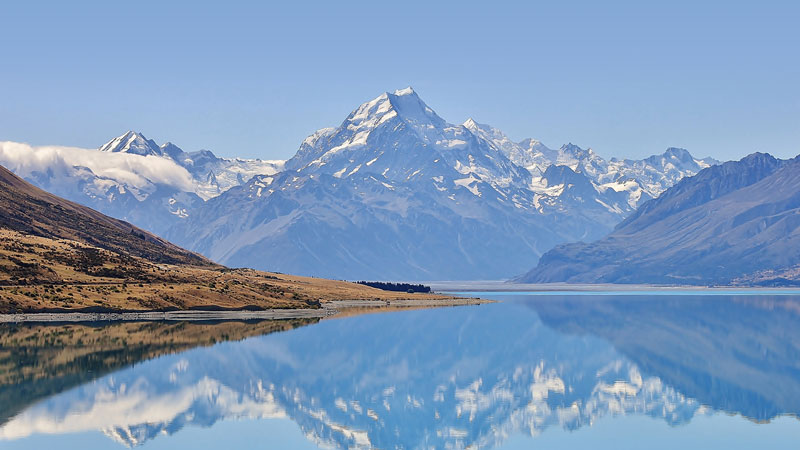
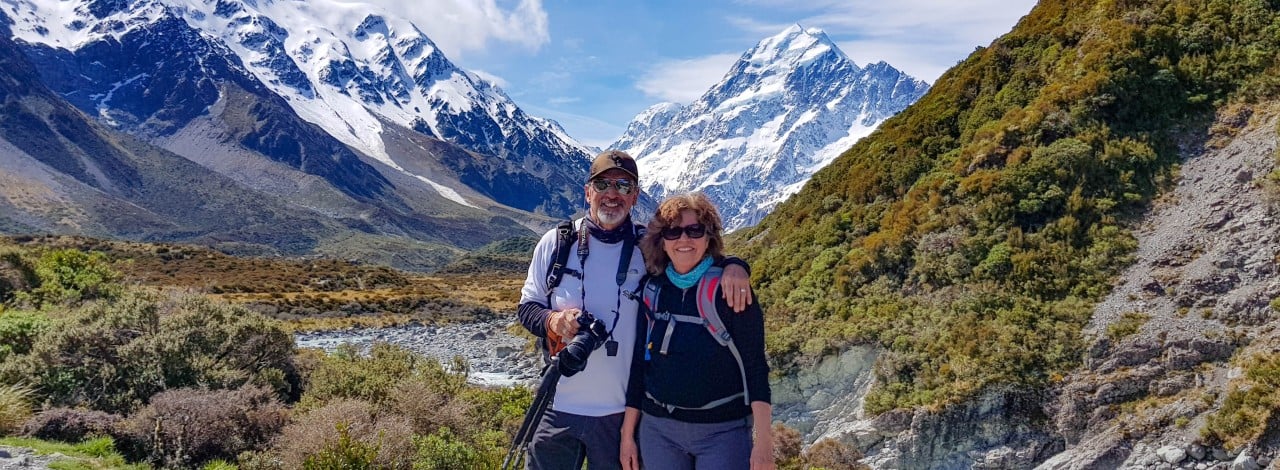
Aoraki / Mount Cook is a highlight for many of our guests, with its spectacular alpine scenery.
A day in Aoraki / Mount Cook National Park
This is a national park that hands you views normally reserved for mountaineers. Beyond its namesake, it holds a further nineteen peaks above 3,000 metres, and there is a walk here for every set of legs.
The big one is the climb to Sealy Tarns, a staircase the locals call the "stairway to heaven", around 600 metres (1,970 feet) of ascent to a pair of alpine tarns and a view over the Mueller and Hooker valleys that is worth every step. If that sounds like more than your knees signed up for, the walk to Kea Point and the Hooker Valley lookout is gentler and just as generous, delivering Aoraki, the glacier and the Hooker River in one sweep. There is more on Aoraki / Mount Cook and the Hooker Valley in our guide to the park.
| Trails Tip |
|---|
| The National Park is the heart of the Aoraki Mackenzie International Dark Sky Reserve, one of the largest in the world. Step outside after dinner, let your eyes adjust for ten minutes, and the Milky Way pours right across the sky. Pack a warm layer; clear nights up here can be chilly. |
Days 3-4: The Mackenzie, Christchurch and the coast to Kaikōura
Lake Pūkaki and the road to Christchurch
The next morning opens on the shore of Lake Pūkaki, where the water is a milky turquoise you have to see to believe. That unreal colour is glacial flour, rock ground to powder by the Tasman Glacier and held in the meltwater, scattering the light. A gentle walk along the lakeshore takes you past ancient kettle holes, shallow dimples left behind by retreating glaciers, with Aoraki standing at the head of the lake behind you.
From there, the land softens across the Canterbury Plains to Christchurch, the South Island's largest city and worth a slow afternoon: the leafy banks of the Avon River, the Spanish Mission frontages of New Regent Street, the extraordinary cardboard cathedral, and street art that has bloomed across the rebuilt centre since the 2011 earthquakes.
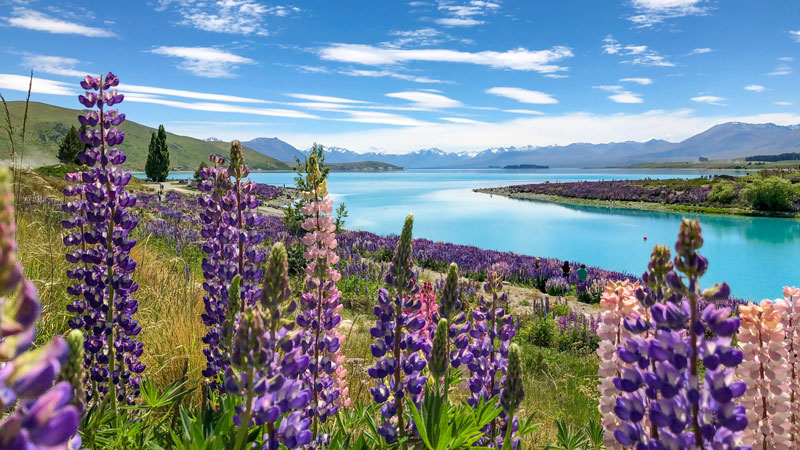
Summer at Lake Tekapo brings fields of vibrant lupins, adding colour and character to one of New Zealand's most picturesque landscapes.
Godley Head and the road north to Kaikōura
A coastal walk on the Godley Head Track is the perfect leg-stretch before the drive north. Out on the cliffs of Banks Peninsula, where a World War II gun emplacement still guards the harbour mouth, you look west to the Southern Alps and east across the wide Pacific. Then it is up the coast to Kaikōura, a small town wedged between snow-capped mountains and a deep, wildlife-rich sea. Dinner, if we are doing it properly, is fish and chips on the beach.
| Trails Tip |
|---|
| Kaikōura sits on the edge of a deep undersea canyon that comes close to shore, which is exactly why the marine life here is so extraordinary. Sperm whales feed in that canyon year-round, so the wildlife watching is a sure thing in any season, not a summer-only treat. |
Days 5-7: Kaikōura, Queen Charlotte Sound and Nelson
Swimming with dolphins
Set an early alarm, because this is a morning you will be telling people about for years. Off Kaikōura you can swim with dusky dolphins, a small and gloriously acrobatic species that gathers here in pods that can run into the hundreds. They are entirely wild, so it is their choice whether to come and play, and more often than not they do, looping and leaping around you. Prefer to stay dry? Watching from the boat is every bit as joyful, and the same waters turn up fur seals, the odd whale, and seabirds galore.
| Trails Tip |
|---|
| Even if you are not sure about getting in the water, book onto the dolphin swim rather than the watch-only boat. You can always stay aboard, and the swim boats carry fewer people and get you closer to the action. |
Across Queen Charlotte Sound
From Kaikōura you carry on north to Picton, gateway to the Marlborough Sounds, where a water taxi ferries you across Queen Charlotte Sound to a remote lodge set among native bush and birdsong, reachable only by boat. The next morning you climb into kayaks and paddle back through hidden coves and quiet bays, which is, hands down, one of our favourite ways of getting out on the water anywhere in the country.
Marlborough wine and the sunny city of Nelson
You are now in Marlborough, the region whose Sauvignon Blanc made New Zealand wine famous, so it would be rude not to stop for a tasting. From there, it is a short hop to Nelson, reputedly the country's sunniest city and the gateway to golden-sand Abel Tasman National Park. Nelson earns a free day in this fortnight: arts, craft beer, orchards and beaches, with a cruise or a kayak into the Abel Tasman on offer if you would rather stay active.
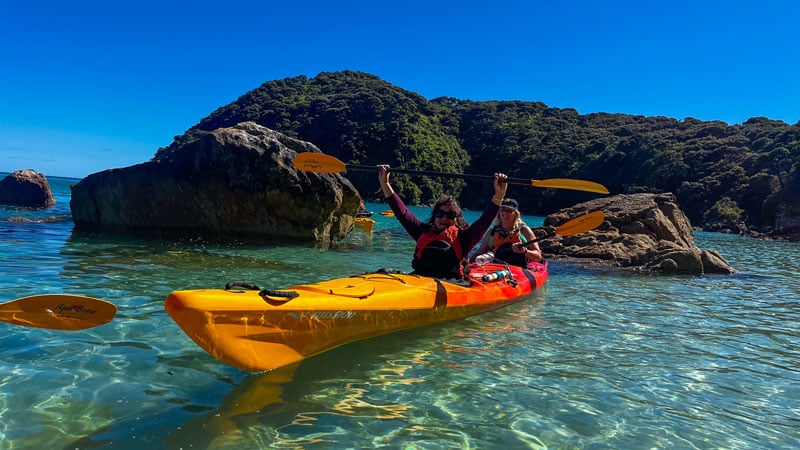
Kayaking through Abel Tasman National Park is one of the best ways to experience its golden beaches, sheltered bays, and crystal-clear waters.
Days 8-9: Nelson Lakes and the wild West Coast
Nelson Lakes and Whisky Falls
Leaving Nelson, you climb to the alpine village of St Arnaud and into Nelson Lakes National Park, where the northernmost peaks of the Southern Alps drop to mirror-still glacial lakes. A walk along the shore of Lake Rotoiti through red beech forest brings you to Whisky Falls, a 40-metre (130-foot) ribbon of water framed by moss and fern, and a fine spot for a picnic.
Then the road tips you over to the West Coast, the wild, rain-soaked, gloriously empty edge of the island that Lonely Planet readers once voted among the best coastal drives on earth. Rainforest meets driftwood-strewn beaches and the Tasman Sea hurls itself at the rocks. The sunsets out here are something else.
The Pancake Rocks, Paparoa and Hokitika
At Punakaiki you walk the Pororari Loop, a track that takes in a section of the Paparoa Track, one of New Zealand's eleven Great Walks, winding through a limestone gorge so lush it feels prehistoric. Close by are the famous Pancake Rocks, stacked limestone formations where, on an incoming swell, the sea explodes up through blowholes in great salty plumes. It is among the Great Walks woven through this route, and a wonderful way to taste a Great Walk without committing to the full multi-day tramp (a tramp, in Kiwi, is a good long hike).
Further south, the little town of Hokitika is the home of pounamu (greenstone, the treasured South Island jade), and you can watch carvers at work before an evening tucked into Glacier Country at Franz Josef.
| Trails Tip |
|---|
| Time the Pancake Rocks for an incoming tide if you can; the blowholes only really perform when the swell is up and the sea is pushing in. And keep your rain jacket handy on the Coast. The weather here is part of the show. |
Days 10-11: Glacier Country, Haast and Wanaka
Lake Matheson's mirror and the Haast jet boat
Morning at Lake Matheson is one of the quiet wonders of this trip. On a still day, the tea-coloured water throws back a flawless reflection of Aoraki / Mount Cook and its neighbour, Horokōau / Mount Tasman, with the native forest framing the lot.
Then you head south and inland over the Haast Pass, swapping the coast for the jet boat: a thrilling, only-in-New-Zealand ride up a braided river into a World Heritage wilderness most visitors only glimpse from the road. The jet boat is a genuine Kiwi invention from the 1950s, dreamed up by Bill Hamilton to skim the shallow rivers of the high country, and still one of the most exhilarating ways into the backcountry.
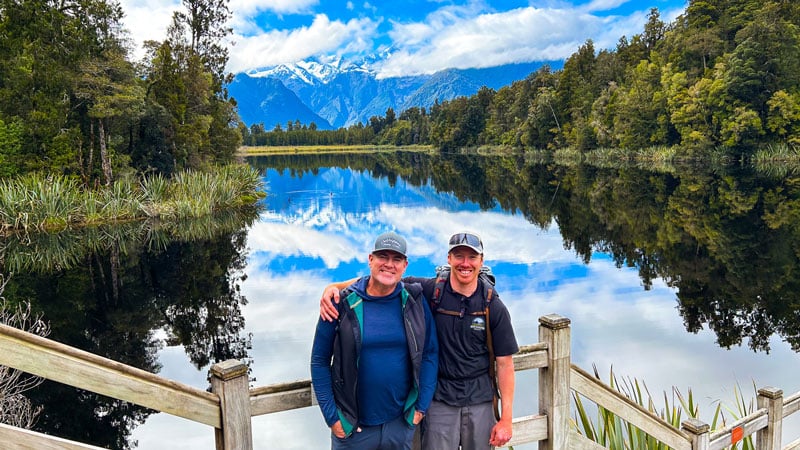
Lake Matheson is famous for its reflections of Aoraki / Mount Cook and the Southern Alps.
Walking above Wanaka
By evening you are in Wanaka, the relaxed lakeside town that locals quietly prefer to its flashier neighbour. The next morning is yours to take at your own pace: a climb to Diamond Lake and on up the Rocky Mountain track for a sweeping view over Lake Wanaka and the surrounding peaks, or a slow wander through town with a flat white (the Kiwi coffee you will quickly come to love), a browse of the galleries and the obligatory photo of "that Wanaka tree" standing in the shallows.
| Trails Tip |
|---|
| Lake Matheson rewards the early riser more than almost anywhere on this trip. The reflection is at its glassy best in the first hour after dawn and before the wind gets up, so set the alarm and bring a thermos. You can have your relaxed start tomorrow in Wanaka. |
Days 12-14: Fiordland, the Kepler and Milford Sound
A day on the Kepler
From Wanaka you make your way south into Fiordland, the wild heart of the south, and your first proper taste of it is a section of the Kepler Track. One of New Zealand's eleven Great Walks, the Kepler is all vivid green moss, towering red beech and sudden views, and an afternoon on its lower reaches, ending at a viewpoint over a golden wetland, is a soft, beautiful counterpoint to the drama still to come. That evening you settle into Te Anau, the lakeside town that is the true gateway to the fiords.
Milford Sound, the eighth wonder
Then comes the day the whole fortnight has been quietly building towards. The drive into Milford Sound, Piopiotahi in te reo Māori, is a highlight in itself, climbing through the Eglinton Valley and the dripping Homer Tunnel with cheeky kea, the alpine parrot, very likely to inspect your boots at the top. Out on the water, the scale of the place finally lands: Mitre Peak rising sheer to around 1,690 metres (5,550 feet), waterfalls plunging down rock walls that climb more than 1,200 metres (3,900 feet) on either side, and seals, penguins and dolphins about the boat.
Māori tradition tells that the atua (god) Tū-te-raki-whānoa carved these fiords with his toki (adze), and that the goddess Hine-nui-te-pō released te namu (the sandflies) at what is now Sandfly Point, worried that somewhere this beauty would tempt people to stay forever. If the famous multi-day walk into the Sound is calling you instead, know that the Milford Track is a multi-day Great Walk in its own right, and a wonderful trip another time.
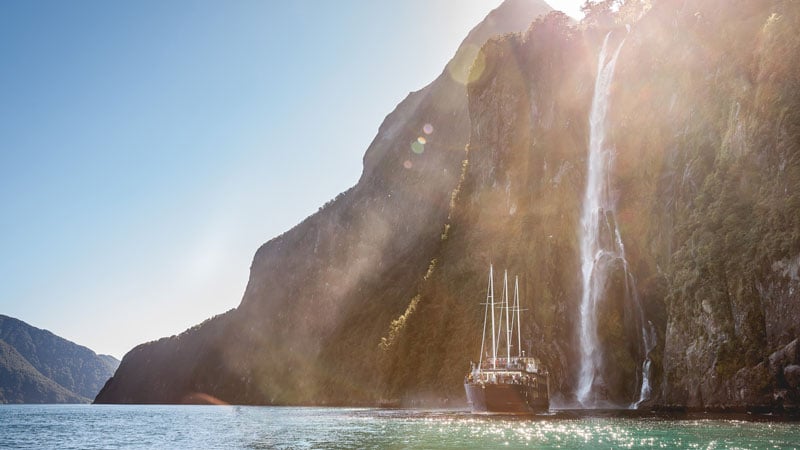
Cruising through Milford Sound is a highlight for our guests, with towering cliffs, waterfalls, and dramatic Fiordland scenery.
The last walk: Jack's Point to Kelvin Heights
On your final morning, the road traces the shore of Lake Wakatipu back to Queenstown, where there is time for one last walk: the Jack's Point to Kelvin Heights trail, a local favourite that follows the lake with the jagged Remarkables range filling the view. A fitting last look before the farewells.
Going guided with New Zealand Trails
If this sounds like the New Zealand adventure you’ve been dreaming of, our Masterpiece tour is the trip for you. It’s based on this exact itinerary – but with all the bookings, logistics, and daily details taken care of. There’s a reason it’s been our most popular tour for over 15 years.
If you’d like to find out more, download the full Masterpiece itinerary here.
Download the Masterpiece Itinerary
Short on time? A one-week South Island itinerary
Not everyone has a clear fortnight, and a well-built week in the South Island is still the trip of a lifetime. If you have seven to ten days, do not try to water down the whole loop. Keep the south, where the walking is at its very best.
A one-week itinerary we love: a couple of nights around Queenstown and Wanaka, two or three nights in Te Anau for Milford Sound and a day on the Kepler, and a night or two beneath Aoraki. You will drive far less, walk a good deal more, and never once feel you are racing the clock. For the "ten days in New Zealand" planner who wants the highlight reel without the logistics, our 7-day Pure South strings the best of the south together at a relaxed pace.
| Trails Tip |
|---|
| Flying in for a shorter trip? Fly straight into Queenstown rather than Christchurch. You land right in the middle of the best walking country and save yourself a long drive south, turning a tight week into a generous one. |
Self-drive or guided? An honest look
Plenty of people drive the South Island themselves and have the time of their lives, and we would never tell you otherwise. A self-drive New Zealand South Island road trip gives you freedom, flexibility and the simple joy of pulling over whenever a view demands it. If that is your style, go for it with our blessing.
It does ask a fair bit of you, though. The full loop you have just read is the better part of 2,700 km (around 1,700 miles), much of it on narrow, winding roads, driven on the left, over alpine passes. The best walks want someone reading the weather (MetService is the forecast locals trust) and the Department of Conservation (DOC) track updates daily. And a fair few of the highlights, the dolphin swim, the water taxi and lodge in Queen Charlotte Sound, the Haast jet boat, the Milford cruise, are timed, weather-dependent bookings that all have to slot together.
That is the case, simply put, for letting someone else carry the logistics. Not because guided is better than independent, but because it changes the trip you have. No wrong turns, no scramble for bookings, no white-knuckle passes in the rain. Someone else takes care of it all. When the driving, the bookings and the weather calls are handled, your only job each day is to walk, to look, and to fall for the place. You travel between trailheads in a comfortable late-model Mercedes-Benz Sprinter with your luggage following along, you arrive rested rather than frazzled, and you have two Kiwi guides who know which side of the valley the light will be on, and which leg most people rush.
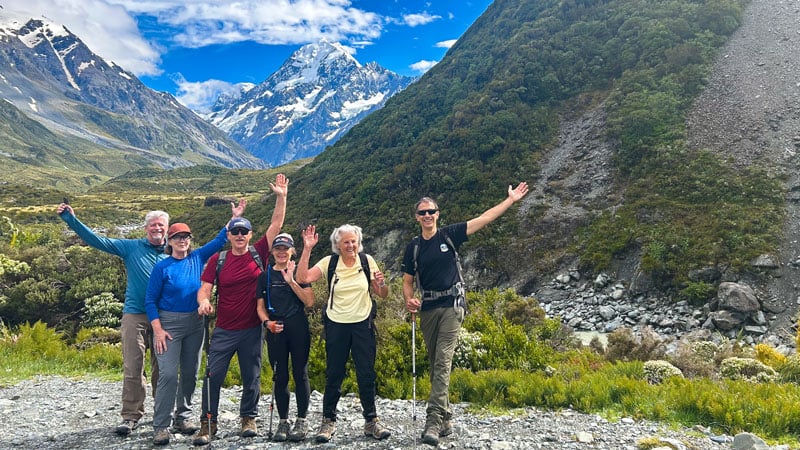
Our expert local guides bring each destination to life, sharing their knowledge, stories, and passion for New Zealand.
Walk the South Island with us
The fortnight you have just read is, day for day, the trip we run as our Masterpiece. If it is the two weeks you have been picturing, you do not have to build it yourself.
What our guests say:
"Our Masterpiece trip was the adventure of a lifetime. We had high expectations and those expectations were exceeded in every way. Prior to the trip we assumed New Zealand would be a country we checked off our list and would not return to again. Because of our experience with New Zealand Trails, we are already talking about what we will do when we return to the South Island again." - Cindi Spence, March 2026
Walk the iconic two weeks: the Masterpiece. From Aoraki to Milford, the wild West Coast to the Kaikōura coast, our 14-day Masterpiece follows exactly the route above, with the driving, the bookings and the weather calls all handled, and your feet on the ground every single day. Two Kiwi guides, a small group, and your only job is to soak it all in. If this is the trip you have been dreaming of, we’d love to show you around.
Prefer a touch more luxury: the Grand Explorer. If you like the look of this fortnight and lean towards a more premium style of travel, the Grand Explorer, our more premium take on the same fortnight, covers the length of the South Island at an easier pace, with a few extra flourishes along the way.
And for those looking for the ultimate New Zealand hiking experience, the Kiwi Classic is the best way to experience the best of New Zealand’s backcountry on foot.
A warm welcome south
Two weeks, walked well, is the South Island at its very best: Queenstown to Milford, Aoraki to the Kaikōura coast, beech forest and the alpine and that impossible turquoise water, with a flat white at the start of each day and a good yarn (a chat) at the end of it. Build it yourself and you will have a wonderful time. Hand us the logistics and you will have a wonderful time with nothing on your mind beyond the next bend in the track.
If this is the two weeks you have been picturing, we would love to walk it with you. Tell us when you are thinking of coming, and we will help you build it. To start dreaming on paper, request your free copy of our brochure, and we will get you out among the mountains.
So, come on down. The tracks are waiting.
Recent articles